The Raritan Blog
Home » Raritan Blog
DCIM – How Do I Decide What’s Right For Me and Cut Through All the Hype and Confusion?
July 15, 2011
As SVP of Global Sales and Marketing for Raritan, I have had the opportunity to speak with many different companies around the world that have been considering a DCIM solution. In most cases, the conversation quickly turns to “with over XX companies and growing claiming to have some sort of a DCIM solution out there today, how do I chose the right one?” I can see the frustration on their faces as they try to decide which solution is right for their specific needs. At this point I tell them to take a deep breath and then I try to help them simplify the problem down to some basic needs.
First, let’s identify your top one to two most pressing needs. What problem or problems are you trying to solve? Are they in the areas of asset management, capacity planning, energy management, visualization, change management or environment management? Sure many of the companies that offer solutions in the DCIM space claim to offer all of these features, but do they really solve the problem that you are facing? Chances are not. Don’t try and boil the ocean. Solve for the few biggest problems first.
Raritan at Cisco Live!
July 1, 2011
Raritan Booth #849
July 11-14, 2011
Mandalay Bay Resort and Convention Center
Las Vegas, Nevada
Data Center Monitoring
Greg More
June 22, 2011
Raritan recently contracted with the Datacenter Research Group (part of the Datacenter Dynamics organization) to conduct primary research and produce a white paper on monitoring power and environmental conditions in United States data centers.
The key findings are that most owners and operators of data centers engage in monitoring proving the mantra “you can’t manage what you don’t measure.” However, the research also pointed out some of the inadequacies of past practices.
- The vast majority of US data centers monitor energy consumption, temperature and humidity, typically on a “continuous” basis.
- Energy efficiency, carbon output and power quality are monitored irregularly and only within the primary/main facility.
- In some cases, reporting is led by what the technology can deliver rather than what the facility requires. Reporting is critical in translating “data” into actions.
- Levels of satisfaction with monitoring and reporting are at best “subdued.” Linking monitoring and reporting to continual improvement processes increases satisfaction levels.
- There are concerns about the ease of integrating different monitoring processes to provide a “whole of portfolio” picture.
- As data centers move towards becoming “dynamic” facilities, monitoring needs to move from simple to multivariate analyses, from simple alerts to establishing control and moving from reaction to prediction.
The 14-page research white paper and two-page summary are available at: White Papers | Resources - Raritan.
For Existing CC-SG Customers It's Easy to Migrate to a Virtual CC
May 24, 2011
My last few blog posts have focused on the benefits of deploying the CommandCenter Secure Gateway as a virtual appliance (VA). Now, with the release of CC-SG 5.1, it’s time to talk about how CC-SG hardware appliance users are shifting over to a “virtual CC”.
First, a quick review… In November 2010, Raritan made CC-SG 5.0.5 available as VA — thereby providing customers with two deployment options: physical (i.e. hardware) or VA. Version 5.0.5 was the vehicle for delivering “Virtual CC” to the market; 5.0.5 firmware does not run on the physical appliance.
Now back to the future. I specifically mentioned release 5.1 above because this is the first version of CC-SG firmware that can run on either the physical or the virtual appliance. Because of this, the two appliance types are interoperable and the CC-SG database of one 5.1 unit can easily be copied over to another 5.1 unit — physical or virtual. As a result, physical appliance owners now have an easy avenue toward moving to a virtual appliance if desired.
How to Calculate Current on a 3-phase, 208V Rack PDU (Power Strip)
Henry Hsu
March 14, 2011
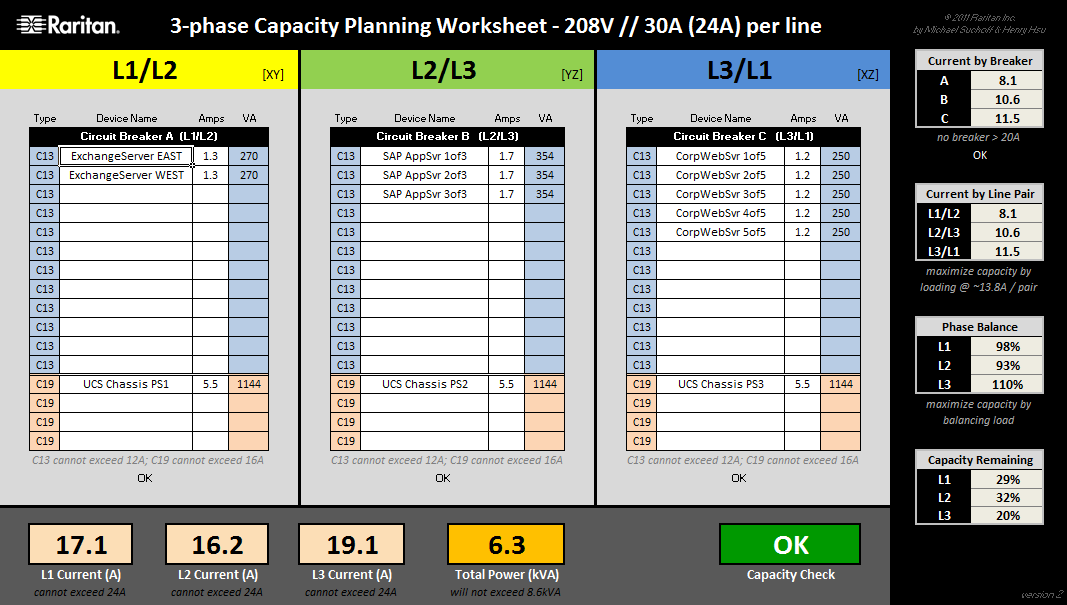
Problem Statement
In recent years, extending 3-phase power distribution all the way to server cabinets and racks has become extremely popular in new data center builds—for many good reasons. Principally, for cabinet power capacities above 5kVA, utilizing 3-phase rack power strips can significantly reduce the copper required to supply such dense loads.
But unfortunately, many users (rightly) find it cumbersome to provision and calculate current (amperage) for 3-phase power in the rack—for example, a typical question would be:
Subscribe
Upcoming Events
Latest Raritan News
- Legrand Introduces Next-Generation KVM Platform Built to Bring Critical Systems Back Online in Minutes
- Posted on July 20, 2026
- Greater Choice, Scalability, Speed: Why Legrand is Doubling Down on Open Compute Project Innovations
- Posted on October 3, 2025
- Legrand Brings Greater Flexibility to Data Center Operators with New Intelligent Rack PDU Universal Input Option
- Posted on February 26, 2025
- Legrand Expands Full Suite of DX2 SmartSensors, Keeping Data Centers Ahead of Rack Power and Environmental Monitoring Challenges
- Posted on December 18, 2024
- Legrand Wins Back-to-Back Awards for Intelligent Rack Power Distribution Innovation
- Posted on May 24, 2024