White Paper: 5G, Smart Cities, and Edge
5G, Smart Cities, and Edge — The IoT in Our Lives
by Marc Cram
Download PDF

THE INTERNET OF THINGS IN OUR LIVES
The Internet Engineering Task Force (IETF) defines the Internet of Things (IoT) as being “the network of physical objects or ‘things’ embedded with electronics, software, sensors, and connectivity to enable objects to exchange data with the manufacturer, operator, owner and/or other connected devices.”1
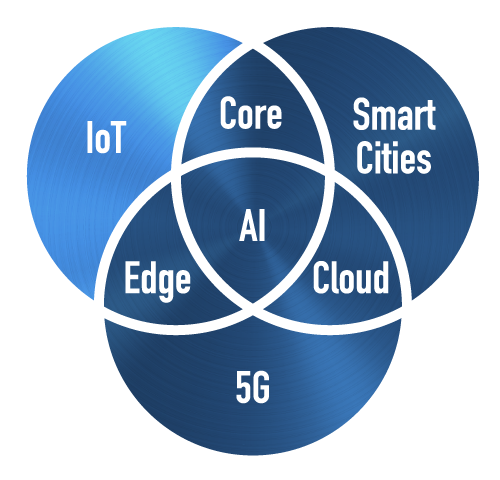
The very phrase “Internet of Things” conjures up visions of everyday items becoming chock full of semiconductors, and what once was science fiction is today’s reality. A degree of digital wizardry can be found in many consumer products such as clothing, shoes, furniture, tools, lighting, appliances, toothbrushes, mirrors, and drones, the list is too big to include everything here. Suffice it to say that the things we see, touch, and use every day are all being “digitized.” We are surrounded by sensors of all kinds — cameras, microphones, radiation badges, smoke detectors, carbon monoxide detectors, accelerometers, NFC readers, occupancy sensors, the list is endlessly being expanded with each passing moment. Whether the data coming from these devices is riding on BACnet, Modbus, SCADA, Wi-Fi, Bluetooth, or Ethernet, eventually it all winds up passing through or residing on the internet.
Smart Cities around the globe are relying on an ever expanding deployment of IoT devices coupled with 5G wireless infrastructure and edge computing to bring new levels of service and information to their citizenry.
In this industry brief, we discuss the IoT, its relationship to Smart Cities and 5G wireless, and how IoT, Smart Cities, and 5G will require remotely managed intelligent power to deliver on the promises of better information and control, resulting in improved lifestyles and greater efficiency.
1. https://www.ietf.org/topics/iot/
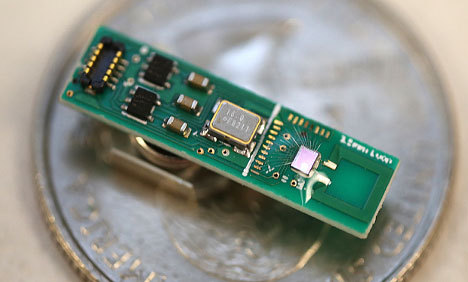
The Bluetooth transmitter chip is connected to a magnetic monopole antenna, which acts as an integral part of the transmitter’s resonator circuit. The left half of the circuit board is only for test purposes. This device consumes 0.6mW at full power transmission and is half the size of a dime.
WHERE IS THE IOT?
Near me
The number of IoT devices that fall into the “Near me” category is too numerous to name them all. Suffice it to say that IoT devices are in our homes, our offices, our vehicles, on the roadways, at the stoplights, and on our bridges and railroads. They measure temperature, humidity, air quality, foot traffic, vehicle traffic, room occupancy, light intensity, water flow, power consumption, sound levels, and even watch for wildfires. They control elevators, HVAC systems, heat water, chill water, open and close window shades, run the sprinkler when it hasn’t rained, turn lights on and off, open our garage doors, actuate our brakes when we get too close to another car, sound an alarm when we veer out of our lane, and keep us from skidding if we lose traction. IoT devices display traffic information, answer tourist questions, and find an available parking space. They report the status of power generation facilities and communicate the turbine's state of health back to the manufacturer.
Many of the “Near me” devices also fall into the category of the Industrial IoT (IIoT) category. IIoT can be found in factories, treatment plants, and public works projects. Many IoT devices that fall into the “Near me” category are so pervasive and ubiquitous that we no longer even notice their presence.
On me
The IoT “On me” is easier to relate to for most people. It comes in the form of what we wear and what we keep in our pockets. RFID tags are embedded into our clothing that harvests RF (radio frequency) energy and communicate with a nearby reader to report the location (anti-theft). The IoT “On me” could be a hat that has a scrolling LED display driven by an internet connected Raspberry Pi Zero W. It could be the Samsung Gear on your wrist, or an Apple iWatch. And it’s the smartphone in your pocket, with its Wi-Fi, Bluetooth, and cellular data connectivity.
The Citizen Sensor is a concept described in the Legrand white paper “Smart Cities Run on Smart Power.” The typical person carries microphones, cameras, GPS, accelerometers/tilt sensors, and a magnetometer/compass all inside a single smartphone. Some people carry two complete sets because they have a working smartphone and a personal smartphone. Many even carry a third set in a tablet or laptop they always keep with them.
In me
32-bit ARM-based programmable microcontrollers can now be found in packages as small as 1.5 x 1.5 mm. That makes them about the size of a coarse grain of sand.
Embed that!
While most people would say that there is no IoT “In me,” it is only a matter of time before they will be saying otherwise. Already people are having chips implanted to conduct Commerce, open doors, and unlock their computer screens. Heart attack victims are fitted with pacemakers that download data wirelessly and accept wireless firmware updates. Scientists have been working on connected sensors that can be swallowed to show what is going on throughout the digestive tract. Some of these measure acidity or other chemical properties, while others have cameras or radioactive sources. And they link to diagnostics equipment that is tied to the internet.
Other potential applications for IoT “In me” might be nanomachines in the bloodstream that aid white blood cells in fighting diseases, repair radiation damage, or reduce the effects of aging. Still others might be used to supplement muscles or other tissues damaged by physical injury. Wouldn’t it be great if you could program a set of nanomachines to filter out the effects of a lingering hangover or correct your vision without surgery?
SMART CITIES
By the year 2050, projections show that 70% of the world’s population will live in cities.
In Smart Cities, the IoT relies on a mix of wired and wireless networks such as 4G/5G cellular networks and other wireless data technologies like Wi-Fi, LoRaWAN, ZigBee, and LowPAN to collect data, act on data, and deliver services to the citizens of the city.
The IoT enables both monitoring and control for city planners and city managers. People movement, traffic, potholes, parking spaces, air quality, water system and sewer systems are all part of the infrastructure that cities will bring under their watchful eye with ever-expanding capabilities being delivered in ever finer detail. Where they once used cameras to watch the freeways, they now use embedded traffic counters to know the speed and velocity of every single vehicle. Where they once had a status panel in the local utility showing water flowing out to the mains, now they know the pressure, the volume, and status of every single pipe to every structure throughout the city and anticipate what will happen to the water system when the local baseball game takes the “seventh inning stretch.”
Smart Cities will also look to optimize their energy bills by dimming or turning off streetlights when not needed, turning down the power to city-managed Wi-Fi systems when usage is low, or reducing the frequency of mass transit whenever loading is too light to be efficient.
Furthermore, Smart Cities expect leveraging IoT technology to have smart buildings that can shave energy demand, generate their own local solar power, or put power back into the grid from on-site energy storage systems.
Even garbage collection in the Smart City is being optimized through the IoT. Smart garbage cans have solar panels to supply power to compact their contents and wirelessly notify collectors whenever the bin is full. Companies such as Waste Management anticipates the day when they can dispatch an autonomous (driverless) garbage truck to empty the smart garbage cans found throughout the Smart City on an optimized route that skips collection points that do not yet require service.
5G
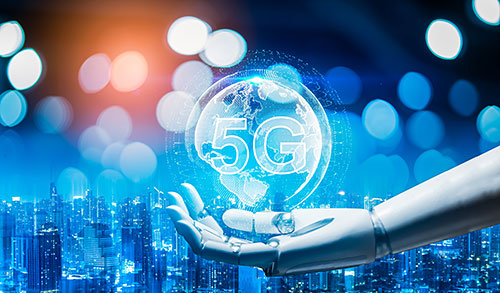
5G wireless is the heir apparent to the ubiquitous cell phone coverage currently blanketing cities worldwide. 5G is designed to take over a wider variety of wireless application services, from low-speed to multi-gigabit requirements. As such, it will become a de facto standard for linking together disparate IoT devices found around the globe, linking them into a highly integrated functional entity capable of monitoring and managing the previously unmanageable.
New radio frequency bands will be used for delivering 5G service, requiring new physical infrastructure having different characteristics from preceding generations of wireless hardware. Antennas will be smaller, and capable of electronically-controlled beam steering. Transmission ranges will be shorter, so distributed antenna systems coupled with an increasing number of micro-cells, picocells, and femtocells (smaller and smaller cell sites) will be needed. These will be found on streetlamps, utility poles, and across rooftops throughout the Smart City. And new smartphones will take 5G to enable more Artificial Intelligence (AI) to take place on the handset and in the public compute cloud.
Some time-sensitive IoT devices will natively embed support for communications over 5G networks. This will eliminate the need for a local gateway or data aggregator device, instead of shifting it to some other cloud server or data storage found in an “edge computing” location that sits on the 5G network.
5G with its high bandwidths and low latency will be the conduit, the data highway, that brings the IoT together in the early 21st century.

EDGE COMPUTING
Edge computing is enabling the promise of 5G to come into being. The one millisecond (1 msec.) latency times expected from 5G require the support of enormous numbers of servers running open stack software to be distributed across the globe instead of in centralized cloud data centers.
The expected growth of demand for mobile streaming video in 4K (and eventually 8K) formats alone is expected to drive the need for local storage of content. But imagine what happens when the cities increase the number of cameras they use to monitor movement, and smartphones begin capturing higher definition videos or delivering AR/VR applications in real time.
“Autonomous” vehicles will require supporting infrastructure in the form of edge computing coupled with data delivered over 5G to meet the high expectations that have been built up around their impending adoption. IoT sensors and other devices will provide autonomous vehicles with the ability to determine their location independent of GPS, will enable applications running on smartphones to summon or reroute vehicles, and to report road conditions in real time. Edge computing will tie the various streams of IoT sensor data together and deliver AI processing in near real time.
IOT RUNS ON INTELLIGENT POWER
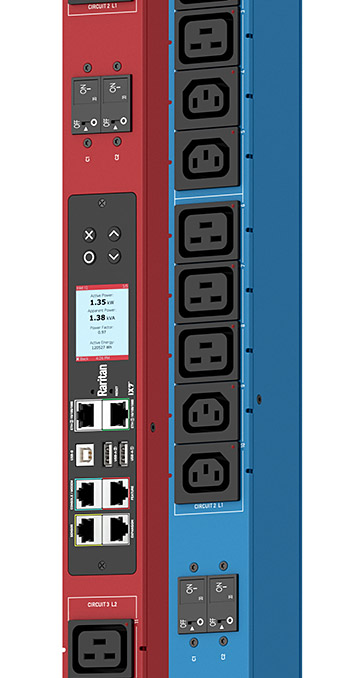
Billions of IoT devices are expected to come online globally over the next decade. Because they will be widely dispersed and require so many ancillary support systems, having remotely managed intelligent power to run both the IoT devices and the systems they work with to make sense both logistically and economically. Intelligent power takes the form of power distribution units that have onboard communications capable of remotely monitoring power consumption, scheduling outlet power on and off, shedding load to maximize uptime when on battery / UPS, and implementing graceful shutdowns whenever a temperature threshold is exceeded.
The IoT will have gateways, aggregators, and edge compute locations distributed across a myriad of environments physical environments and operating conditions and will no longer be confined to a centralized data center. As such, getting a trained technician out to the hardware takes time and money. Paying a little more upfront for intelligent power solutions, with remote management capabilities, can help your IoT application or its supporting network get back online faster through automation or a more educated manual intervention.
As brands of Legrand, Raritan, Server Technology and Starline offer the widest variety of intelligent power distribution solutions suited to your most demanding applications. Legrand supports all form factors, outlet counts, and power densities for applications going from the edge to the core and everywhere in between. With over sixty years of combined power experience, we are the leading innovators in the field of intelligent power, and we have the products, the patents and the people to make something for you, from short lead time off-the-shelf to semicustom and full custom solutions.
Come see why so many people trust their mission-critical power needs to Legrand.

WHY SERVER TECHNOLOGY
Server Technology’s power strategy experts are trusted to provide rack PDU solutions for demanding data centers worldwide ranging from small technology startups to Fortune 100 powerhouses. Because power is all we do, you will find us in the best cloud and colocation providers, forward thinking labs and telecommunications operations. Server Technology customers consistently rank us as providing the highest quality PDUs, the best customer support, and most valuable innovation. Let us show you – we have over 12,000 PDU configurations to fit every need, and over 80% of our PDUs are shipped within 10 days.
Interested in learning more about how Server Technology can help you manage and distribute power in your application?
Visit us online at www.servertech.com
WHY RARITAN
Raritan, a brand of Legrand, is a global leader in intelligent rack PDUs, KVM switches, and other data center infrastructure monitoring and management solutions. Raritan’s innovations improve the reliability, efficiency, and intelligence of data centers and server rooms around the globe — including those of the top Fortune 500 companies, such as Cisco, Dell, Google, HP, IBM, Intel, and Microsoft.
To learn more, visit www.Raritan.com
WHY LEGRAND
At Legrand, we build sustainability into everything we do. We are committed to developing solutions that enable high performance buildings (such as data centers), reducing the environmental impact of our own operations and transforming how people live and work — more safely, more comfortably, more efficiently. We were ranked 51st among the Global 100 World’s Most Sustainable Corporations in 2018. In addition, Legrand North and Central America was recognized by the Department of Energy (DOE) in 2018 for achieving a 20.3 percent reduction in energy intensity. We are committed to optimizing the way we manage energy, water and waste because these practices are good for the environment and good for business.
Download PDF